
Table of contents
Quick summary
- Online media with a large archive starts at IDR 8,000,000 per year on Website GEO, up to 500 pages
- A newer outlet fits Website SEO from IDR 5,000,000 per year, up to 150 pages
- Reporter, editor, and managing editor roles plus scheduling are an app module at IDR 5,000,000 per module per year
- Old article addresses are mapped to permanent redirects before the new site replaces the old one
- Hosting, SSL, server, a WhatsApp group, and unlimited revisions for a year are included. The domain is bought separately in your company name
Readers are not the ones paying the bills
News readers rarely type the name of the outlet. They arrive from a phone feed, from a search about something that just happened, or from a link forwarded in a chat group, read one page, and leave. That traffic is large, and it never fills in a form.
The paying searches come from advertisers, agencies, and press officers. They look during office hours, compare several outlets at once, and ask the same things: monthly readers, which sections perform, what the ad formats cost. With no answers on the site, the outlet drops off the shortlist.
- Advertisers: online media rate card, advertorial pricing, news placement packages
- Press officers: press release publishing, event media partner, verified online media
- Contributors: regional reporter openings, submission rules, newsroom contact
Newsroom flow: morning briefing, night shift, timed publishing
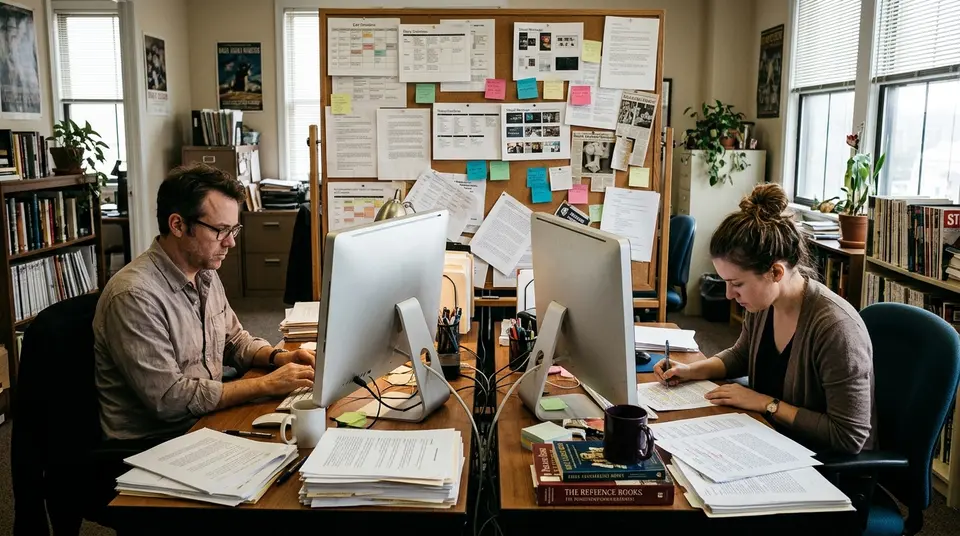
A story passes through four pairs of hands in a day: the assignment at the morning briefing, a reporter filing from the field on a phone, an editor fixing the headline and the figures, then the managing editor choosing when it goes up. So the panel needs draft to published states, per person permissions, and a scheduler for embargoed releases.
The change log matters as much as the publish button. A headline quietly rewritten at eleven at night, or a casualty figure revised with no note, is a trust problem. So each article records who changed what and when, corrections are stated openly, and an election runs on one live page, not twelve near identical stories.
Ads pay the bills, and often break the page carrying them
The article page is the ad team's workplace as much as a reading surface. Trouble starts when ad scripts hold the text back, and when a slot with no reserved height shoves the paragraph down as someone begins reading. A reader who loses their line closes the tab, and the next impression goes too.
The fix is mechanical, not a matter of taste. Slot heights are locked before the ad loads, anything below the first screen loads late, third party scripts are capped and listed, and an ad layer over the text carries a close button that works. Advertorials get a visible label, and client links are marked as paid, not as editorial endorsement.
Changing platform without losing five years of archive
The riskiest job in online media is not building new pages, it is moving the old archive. Thousands of stories on the previous platform have their own address pattern, and if it changes without a permanent redirect for each one, the archive falls out of search results within weeks.
A large archive also splits crawler attention. Sections and tags need paginated pages a crawler can walk, not an endless scroll. The last two days go in a separate news sitemap, the older archive gets its own, and old stories revive when a topic page for a long case links to them.
What a newsroom uses, and what only adds cost
Online media get pitched things that never touch newsroom work: a phone app readers must download, comments needing a full time moderator, a paywall before there are regular readers, a video player starting by itself on every story. Some of it slows the page that earns the money.
Online media website design earns its keep in unremarkable places: author pages, a masthead with the editorial guidelines, a correction and right of reply procedure, an internal search the reporters rely on, and a rate card page an advertiser can be sent without waiting on email.
- Needed: author pages with honest publication dates, not dates refreshed in bulk
- Needed: a rate card page listing sections, ad formats, and readership figures
- Not yet: a phone app or a paywall before readers return on their own
How Metanotech runs the build
Every online media business website starts from three lists, not a layout: the section structure with its regional channels, the old article addresses needing redirects, and the newsroom roles with who may hit publish. A large archive takes Website GEO from IDR 8,000,000 per year for up to 500 pages, a newer outlet fits Website SEO from IDR 5,000,000 per year for 150 pages, and the schedule is set once the list of old article addresses is complete.
The editorial panel with roles, scheduling, and an approval queue is an app module at IDR 5,000,000 per module per year, server included, and every 5 modules bundle into a IDR 20,000,000 package. The Paket Bisnis Berjalan pairs Website SEO with 3 app modules at IDR 20,000,000 per year. Hosting, SSL, server, a WhatsApp group, and unlimited revisions for a year are included, while the domain is bought separately in your company name. Our office is in Gunung Putri, Bogor, West Java.
Metanotech packages matched to online media needs
| Package | Best for | From, per year |
|---|---|---|
| Landing Page | One event or contributor sign ups, 1 page | IDR 2,000,000, ready in 3 to 5 working days |
| SEO Website | Newer outlet, limited sections, up to 150 pages | IDR 5,000,000 |
| GEO Website | Large archive, regional channels, topic pages, up to 500 pages | IDR 8,000,000 |
| App Modules | Role based editorial panel, scheduling, approval queue | IDR 5,000,000 per module, every 5 modules IDR 20,000,000 |
| Paket Bisnis Berjalan | SEO website plus 3 app modules | IDR 20,000,000 |
Frequently asked questions
How much does online media website development cost?
Online media website development starts at IDR 8,000,000 per year on Website GEO for a large archive of up to 500 pages, or IDR 5,000,000 per year on Website SEO for 150 pages at a newer outlet. The editorial panel costs IDR 5,000,000 per module per year.
How long does an online media website take to build?
Scheduling follows how many old article addresses have to be mapped to new ones, how the sections and regional channels are arranged, and how many newsroom roles get separated, not the number of new pages. A single event page is finished in 3 to 5 working days as a Landing Page. Most slippage traces back to an incomplete address list, which is why we ask for that list first.
Can the archive move off the old platform without losing traffic?
Archive migration maps every old article address to its new one behind a permanent redirect, so links already spread through chat groups and search results still land on the right page.
Can an online media site get into news aggregators and phone feeds?
News aggregator requirements are prepared on our side: a news sitemap for the last two days, article markup with author and dates, author pages, and article pages that load fast on a phone. Acceptance stays the aggregator's own call.
Can each person in the newsroom have different permissions?
Permissions split by role: contributors only submit drafts, editors rewrite and send copy back, the managing editor publishes and sets the schedule. Every change is logged with a name and a timestamp, built as an app module at IDR 5,000,000 per module per year.
Can ads run without slowing the article page down?
Ad slots are placed with their height locked so paragraphs never jump, anything below the first screen loads late, and third party scripts are capped. Speed tests run with the ads switched on, not on a clean version.