AI Implementor vs AI Consultant: The Role and How to Choose
An AI implementor takes AI from an idea to something your team uses at work: mapping the process, building and connecting the system, setting guardrails, training users and maintaining it. Unlike an AI consultant, whose work ends with advice and strategy, an implementor stays responsible until the system runs on your data. Metanotech works this way, starting with one workflow and measuring it before expanding.
Quick facts
- An AI implementor builds AI into your systems instead of only writing recommendations
- A consultant suits strategy work, a product vendor suits common needs
- Ask early who owns the code and the prompts, meaning the AI's instructions
- Sensitive actions still need human approval, because AI can be wrong
- The AI model is chosen per use case, not locked to one provider
What an AI implementor does
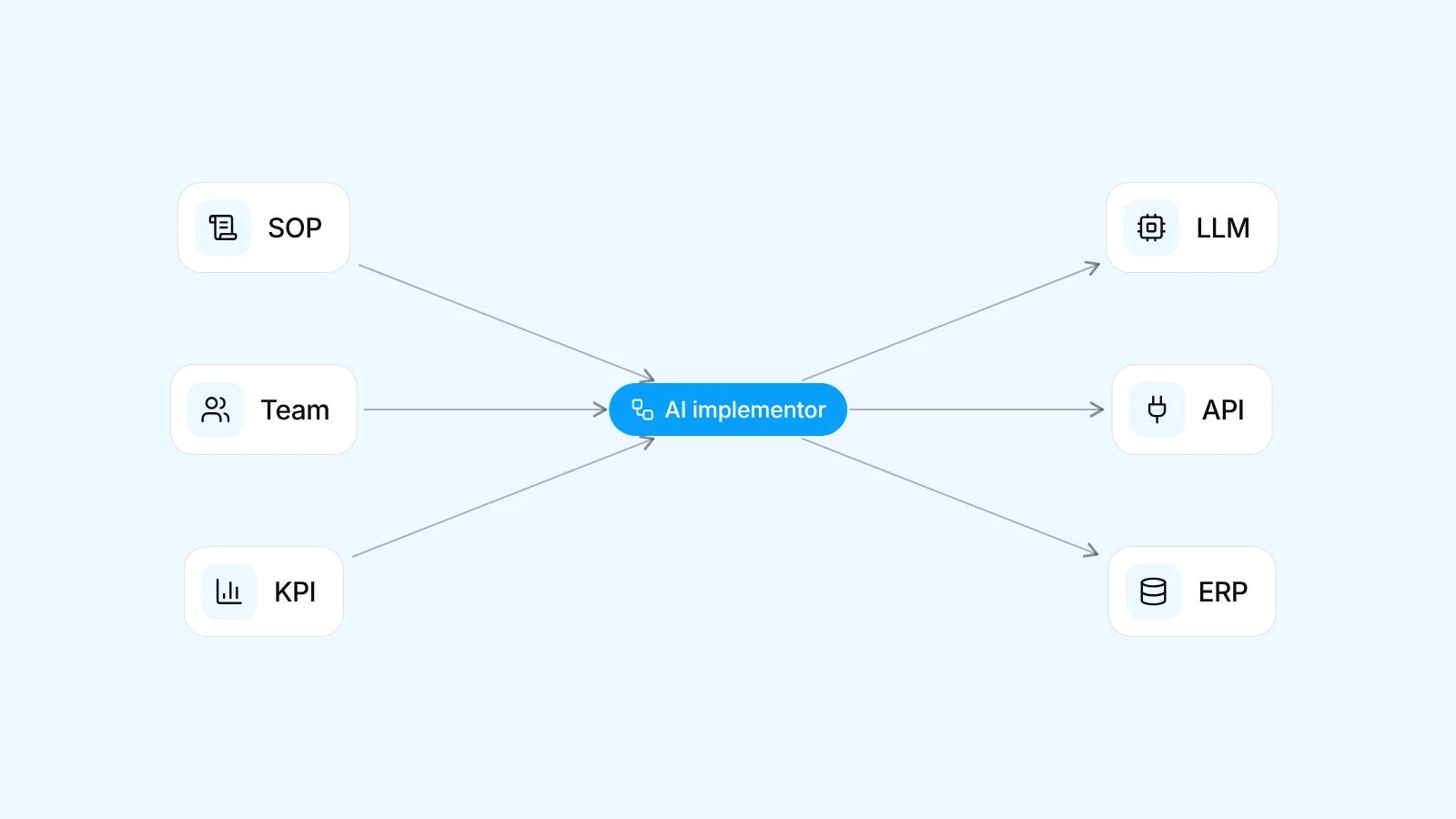
An AI implementor connects a business process to the technology that serves it. The work starts from the process, not the model: who does what, where the data lives and which steps are repetitive language or data work. Once one workflow is chosen, the AI is built and connected to your systems through their API, the route an application opens so other software can read and write its data.
Then come guardrails, the limits on what the AI may do, plus human approval steps, logs of every AI action and user training. The work does not end at launch: business rules change, models are replaced and wrong answers need studying, so maintenance is part of the role.
AI implementor or AI consultant
An AI consultant gives advice and strategy: assessing readiness, mapping opportunities, writing a roadmap and helping choose vendors. The output is usually documents. That helps when your AI direction is unclear or needs agreement across departments. But recommendations do not run themselves, and AI projects easily stall in the gap between a strategy document and a system the team actually uses.
An implementor advises too, but the advice is tested by building. If a workflow is a poor fit for AI, because the data does not exist yet or a simple rule would do, an honest implementor says so first. Many companies seeking AI implementation consulting really need one party that advises, builds and answers for the result.
Versus a product vendor or an in-house team
A vendor selling one AI product, such as a chatbot platform, is quick to adopt when your need is common and fits how the product works. The trade-off: your process adapts, integration is limited and your data sits on their platform. Hiring your own AI engineer gives full control, but one person must cover data, integration, security and the business process. That route makes sense once AI is core to your product or operations, not for a single workflow trial.
Six questions before choosing an AI implementor
When choosing an AI implementor, the answers to these six questions say more than any sales presentation. A party worth hiring answers concretely, including where AI can go wrong. If answers are vague, or every concern meets a promise, treat it as a warning sign and ask to see work that is already running.
- Do we start with one workflow? Ideally yes: a frequent one with a clear owner.
- How is data access handled? The AI gets only what it needs, per role, without sensitive fields.
- Who owns the code, prompts and configuration? Get it in writing, including what is handed over if work stops.
- How is success measured? Against criteria agreed up front, compared with the situation before AI.
- What happens when the AI is wrong? Human approval, traceable logs and a way to fix bad answers.
- What support comes after launch? Who to contact when something breaks, and what work is included.
What happens when the AI is wrong
No AI model is always right. It can misread a document, reach the wrong conclusion or sound confident while wrong, and its output is only as good as the data and access it gets. So sensitive actions, like messaging a customer or changing records, need human approval. Every action is logged, and corrections are used to fix the prompt or data.
The model is not tied to one provider
A party tied to one product tends to use it for every problem. At Metanotech, the model is chosen with the client per use case, for example from the Claude or Gemini families, weighing the task, expected usage and the company's data rules. Sorting incoming messages does not need the largest model, while long, complex documents may need a stronger one.
How Metanotech works as an AI implementor
We start with a free WhatsApp consultation, no commitment, then map the flow that fits your goal. Design runs alongside development, so you see progress along the way. We build module by module, and the next one starts only after your team uses the first in daily work. Our AI portfolio includes a customer service AI, a WhatsApp sales chatbot, and assistants for managing data and for team work.
| Option | Focus | Fits when |
|---|---|---|
| AI implementor | Building, integrating, setting guardrails, training users and maintaining | The workflow is clear, the data exists and you need a working system |
| AI consultant | Advice, strategy, readiness assessment and a roadmap | Your AI direction is unclear or needs agreement across departments first |
| AI product vendor | One ready-made product for one kind of need | Your need is common and fits how the product works |
| In-house AI team | Long-term development with full control inside the company | AI is core to your product or operations and you can hire and grow a team |
Frequently asked questions
How is an AI implementor different from an AI integrator?
Often not by much, since both terms describe similar work. An AI integrator usually focuses on connecting AI to existing systems, for example through an API. An AI implementor covers more: choosing the process, building, connecting, setting guardrails, training users and maintenance. Judge by the scope written in the proposal, not the title.
Does a mid-sized company need an AI implementor?
Not always. If a ready-made product covers a common need, such as a simple chatbot for questions with fixed answers, that may be enough. An implementor is needed when the AI must read internal data, connect to company systems or follow your own approval rules, which is where generic products usually fall short.
Is it better to hire our own AI engineer?
Not necessarily. Hiring makes sense when AI will be core to your product or operations and keep being developed. With one or two workflows, a single engineer would cover data, integration, security and the business process alone. A middle path: start with an implementor, then hire once the direction is clear.
Who owns the code and prompts after the project ends?
It depends on the agreement, so ask and get it in writing before the project starts. Spell out who holds the source code, prompts, configuration and model provider accounts, what happens to the data if the work ends, and what can be handed over if you continue with someone else.
How is the success of an AI implementation measured?
Measure the chosen workflow against criteria agreed before starting, such as the time one task takes, how many AI drafts are used without major edits, or how many questions still go to a person. Record the situation before AI as a baseline, then use that data to decide whether the next workflow is worth doing.
How much does an AI implementor cost?
Pricing depends on what you need and the scope of the work. Tell us about it on WhatsApp, the consultation is free, and we will send you a proposal that fits.
Related services
Start a project
Tell us the problem.We'll build the fix.
Free consultation on WhatsApp. Tell us about your business, what you want to build, and what is getting in the way.