AI Implementation Services for Business
An AI implementation service puts AI to work in one real workflow at your company: choosing the task, preparing data, connecting your systems, adding human approval, and measuring the result before expanding. Good candidates are repetitive language and data work, such as answering customer questions or reading documents. Metanotech handles every stage until your team uses the AI in daily work.
Quick facts
- Starts with one workflow, tested on real data before it expands
- Suits repetitive language and data work, not decisions that need someone accountable
- Sensitive steps such as sending an invoice wait for human approval
- The model is chosen with you per use case, for example Claude, GPT or Gemini
- You prepare sample data, system access and one person in charge
- The first consultation on WhatsApp is free, with no commitment
What an AI implementation service covers
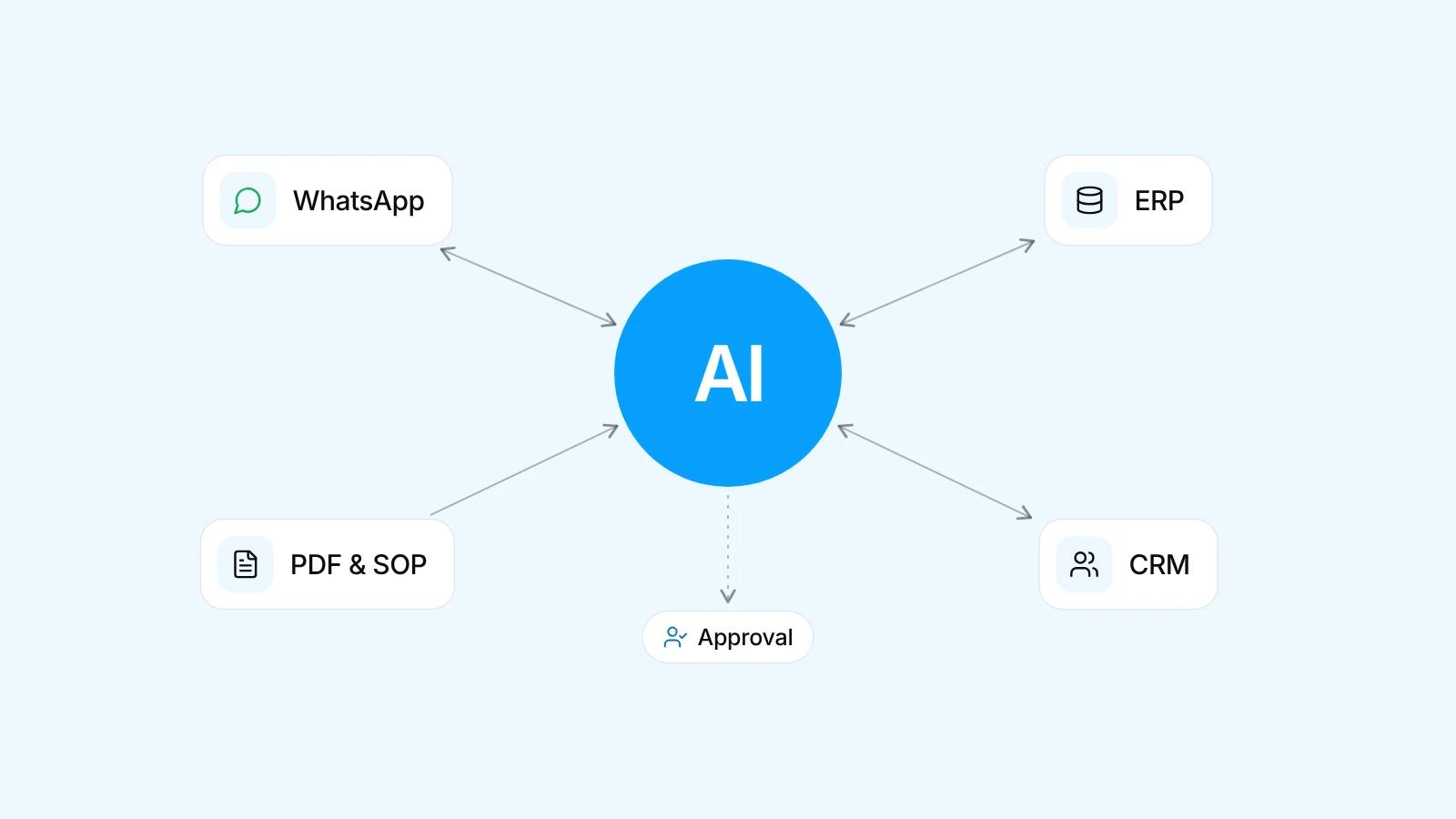
Implementing AI is more than buying a chatbot subscription. The work covers mapping the workflow, choosing a model, writing its instructions (the prompt) and limits, connecting your data and systems, training users and maintaining it after launch. The result may be a WhatsApp chatbot, an AI agent that acts within set limits, AI integration with your ERP and CRM, or a knowledge base built on internal documents.
- A workflow map marking where a person must approve
- Connections through an API, the channel systems use to exchange data, or an export
- Answer limits, access by role, and an audit log of every AI action
Work that suits AI, and work that does not
AI is most useful for repetitive language and data work: answering similar customer questions, pulling details from delivery notes or claim forms, summarising reports, and drafting replies or quotations for a person to check. Each case has material to read, examples of a correct result, and someone who judges the output.
AI fits poorly with decisions that need someone accountable, such as approving customer credit or rating staff performance. AI can prepare the material, but a person decides. It also cannot work without data: if the knowledge lives only in one employee's head, the first step is writing it down, not buying AI.
Signs you are ready, and what to prepare
Readiness for AI adoption depends less on company size than on the state of one process: data that already exists in digital form, even if messy, and someone who knows the process well. Preparation decides the quality of the result, because AI is only as good as the data and access it gets. If it can read the product list but not stock, its availability answers fall short.
- A task your team keeps repeating, such as filling in the same form from incoming emails
- Real samples such as chats, invoices or reports, with sensitive details masked
- Access to the relevant systems, read only at first, by API or export
- One person in charge who knows the process and can decide
- Management backing for a small pilot before any wider rollout
Implementation steps, from one workflow to wider use
The pace is deliberately slow at the start: one workflow that works and is measured honestly beats a pile of unfinished AI projects. The success measure is agreed before the pilot, for example time spent by the team, corrections needed on AI drafts, or questions that still need a human answer.
- Pick one frequent workflow with a clear owner
- Pilot it on real samples, judged by your team
- Connect it to the systems your team already uses
- Set which steps a person reviews before sending
- Measure against the yardstick agreed at the start
- Expand once the first workflow is in routine use
AI risks and how to control them
AI can be wrong, sometimes in a confident voice, so controls go in at the design stage. Answers are limited to the data provided, for example through RAG (retrieval augmented generation), where the AI searches your documents before answering. Sensitive actions such as sending an invoice or changing a customer record wait for a person to approve, and every action is logged.
The second risk is data. Before building, we decide together what goes to the model, who can read the logs and what the provider's data terms say. Sensitive fields the task does not need, such as employee health records, stay out of the prompt, and access is set per role, so warehouse staff cannot ask the AI about finance data.
How Metanotech runs an AI implementation
Everything starts with a free consultation on WhatsApp, with no commitment. We map the flow that makes sense for your goal, and design and development run together so you see progress directly. The system is built module by module: your team uses the first one in daily work before the next starts.
Our AI portfolio includes WhatsApp assistants for invoices, billing and business reports, a customer service AI, a WhatsApp sales chatbot, an assistant for managing data, another for team work, and AI features in a warehouse app connecting stock, purchasing and customer service conversations. Our office is in Gunung Putri, Bogor Regency. Meetings in person around Greater Jakarta can be arranged, and clients elsewhere work with us remotely through a WhatsApp group.
| Solution | Example work | When it fits |
|---|---|---|
| WhatsApp AI chatbot | Answering questions on branch locations and how to become a reseller | Customer questions repeat often and arrive on WhatsApp |
| AI agent | Logging delivery reschedule requests from chat, then asking an admin to approve | Tasks that read a message, then act in a system within limits |
| AI integration with ERP and CRM | Preparing sales meeting material from CRM and ERP data | Systems already run and their data is reachable by API or export |
| AI knowledge base | Answering new staff questions on the purchase approval flow from the SOP | Many internal documents, and staff keep asking the same things |
Frequently asked questions
What is a good first task for AI?
A good first task is language or data work that repeats often and is easy to judge, such as answering similar customer questions or drafting email replies for staff to check. Pick one workflow, test it on real samples, and expand only once the team uses it routinely and the result is measured.
Will AI replace our employees?
Usually not in full. AI takes over the repetitive part of a job, such as retyping data or writing a first draft, while decisions, approvals and customer relationships stay with people. Staff spend more time checking and correcting AI output and less time doing everything from scratch.
What happens when the AI gets something wrong?
AI can be wrong, so the system is built to catch mistakes before they do harm. Answers come only from company data, sensitive actions wait for a person's approval, and the AI hands over to a human when data is missing. Every answer and action is logged, so errors can be traced and fixed.
Is our company data safe to use with AI?
It depends on decisions made before building, and we make them with you. Only the data a task needs goes to the model, sensitive fields are masked or left out, access is set per role, and log access is agreed up front. The provider's data terms are checked when choosing the model.
Which AI model does Metanotech use?
There is no default model we always use. The model is chosen with the client for each use case, for example from the Claude, GPT or Gemini families, weighing the task, usage cost and the company's data rules. Long document reading, customer chat and reporting may each suit a different model.
How much do AI implementation services cost?
Pricing depends on what you need and the scope of the work. Tell us about it on WhatsApp, the consultation is free, and we will send you a proposal that fits.
Related services
Start a project
Tell us the problem.We'll build the fix.
Free consultation on WhatsApp. Tell us about your business, what you want to build, and what is getting in the way.