WhatsApp AI Chatbot Development for Business
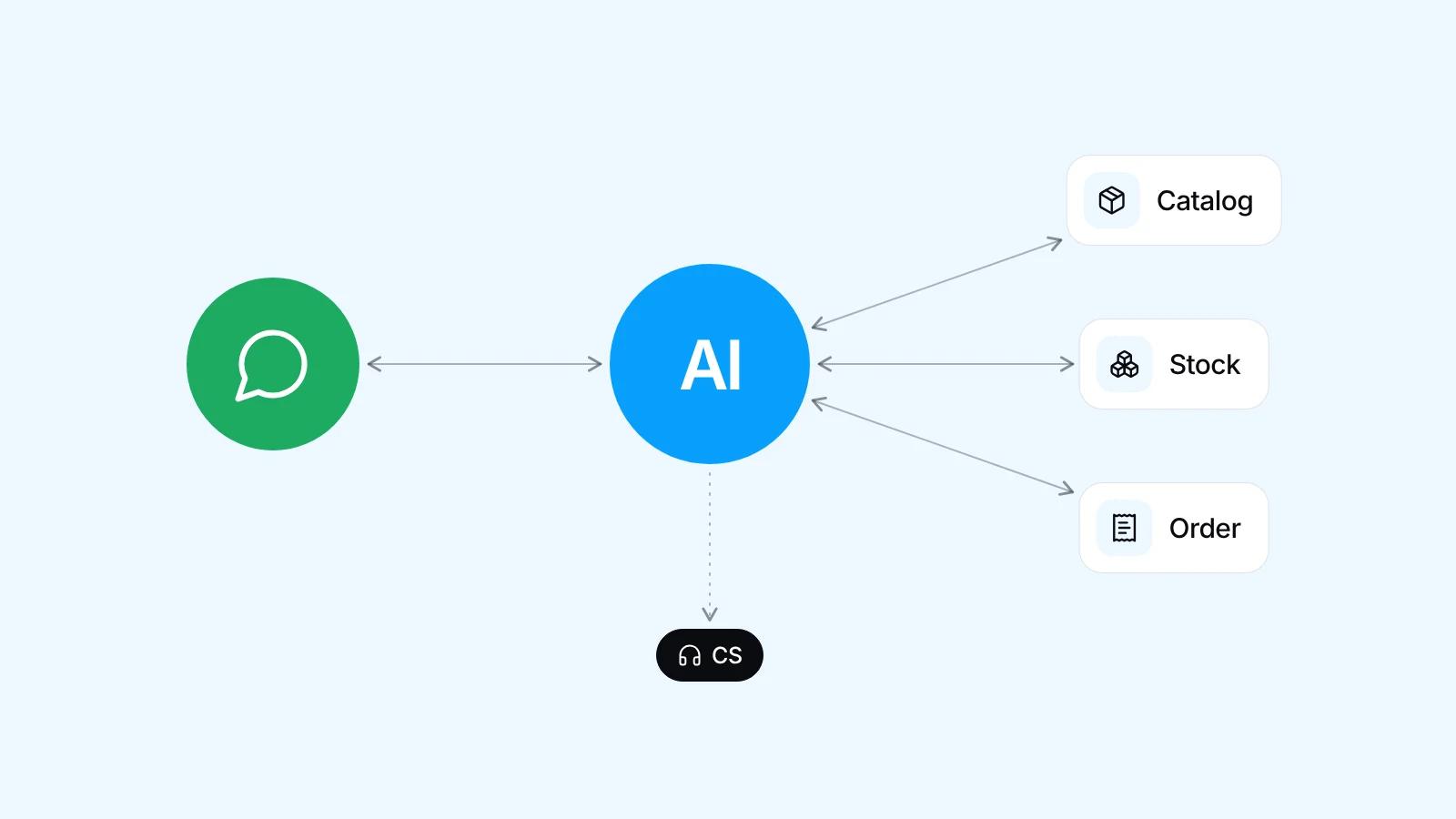
WhatsApp AI chatbot development means building an assistant that replies to customers on your business WhatsApp number in plain language instead of numbered menus. Its answers come from your own data, such as the catalogue, stock, order status and invoices. When a question falls outside that data, the chat goes to a human agent with a summary.
Quick facts
- Customers type their question instead of working through numbered menus
- Prices, stock and order status are answered only from data in your systems
- Chats that need a person go to an admin with a summary of the conversation
- For a main business number, we advise Meta's official WhatsApp Business Platform
- Start with the most common question type, then expand once results are checked
What a WhatsApp chatbot for business can handle
Start with your own chat history and group recent conversations by type of question. Our AI portfolio includes a WhatsApp sales chatbot, a customer service AI, and WhatsApp assistants for invoices and business reports. The principle: questions your data can answer go to the bot, while discounts and commitments to customers stay with your team.
- Common questions: opening hours, how to order, delivery areas, return terms
- Product details from the catalogue: specifications, variants, availability, photos
- Order status by order number or the customer's WhatsApp number
- Lead details such as name, needs and location for your sales team
- Billing reminders and invoice resends from your billing system
Connecting the chatbot to catalogue, stock and order data
The chatbot does not memorise your catalogue. For each question it looks the data up through an API, the official channel systems use to exchange data, in your store or ERP system or a spreadsheet admins keep current. So answer quality follows data quality: if the stock figure in the system is wrong, the bot repeats it convincingly. At first the bot gets read access only. Creating an order needs an AI agent, an AI allowed to act in your systems, with its own approval rules.
Guardrails: the chatbot answers only from data
Guardrails are rules that limit what the AI may answer. They are essential because language models can be wrong: with data missing, a model tends to write a plausible but wrong answer. The most damaging mistakes in business chats are an invented price, stock that is not there, a promised delivery date, or a discount nobody approved.
- Prices, stock and delivery dates only when found in the system's data
- Discounts, refunds, complaints and special requests always go to an admin
- Proofs of payment go to finance for a person to check
- When unsure, the bot says so plainly and hands the chat over
- No requests for passwords, verification codes or card numbers
Handing over to a human agent with a summary
In AI customer service on WhatsApp, a good handover matters more than a clever bot. It is triggered when the customer asks for a person, sounds angry, asks something outside the data, or the bot fails twice. The chat lands in your team's inbox on the same number with a summary of who the customer is, what they asked and what is still open. While an admin handles it, the bot stays quiet.
Official WhatsApp Business API or an unofficial gateway
The official route for a WhatsApp Business API chatbot is Meta's WhatsApp Business Platform, through the Cloud API hosted by Meta. Messages the business sends first, such as billing reminders, must use templates Meta has approved. Meta charges for certain message types, mainly template messages like these, under the rules in force at the time.
An unofficial gateway automates a WhatsApp Web session linked to a phone. It is cheaper and quicker to try, but it breaks WhatsApp's terms and puts the number at risk of being blocked. For a main business number that risk is too high, because losing the number means losing the contact customers know.
Tone of voice: formal or casual
Indonesian customers write in very different registers. An industrial supplier addresses buyers as Bapak or Ibu in full sentences, while a fashion shop suits the friendly kak and short replies. We build the bot's style guide from real replies your admins have sent, and when a customer writes in English, the bot answers in English.
Monitoring conversations and the steps to launch
A chatbot is not finished at launch. Early on, your team and ours regularly read sample conversations: which answers were wrong, when a handover came too late, and which questions have no data behind them yet. Each finding becomes a fix to the rules or the data, then gets checked again.
- Begin with a free, no-commitment consultation on WhatsApp
- Pick the most common type of question and connect its data source
- Write the guardrails and handover triggers with your team
- Test with real conversations before a full launch
- Launch, measure the results, then add the next type of question
| Aspect | Menu bot | AI chatbot |
|---|---|---|
| How customers ask | Pick a number or button | Type freely, typos and all |
| Off-script questions | Back to the main menu | Answered from data or handed to an admin |
| Source of answers | Fixed text per option | Data looked up at that moment |
| Risk of error | Low, the answers are fixed | Can make things up, needs guardrails and monitoring |
| Works well for | Short fixed flows such as registration | Varied questions your data can answer |
Frequently asked questions
How does a WhatsApp AI chatbot differ from an auto reply?
An auto reply sends the same fixed text for every message or keyword, like the greeting in the WhatsApp Business app. An AI chatbot reads the message, works out the question, finds the answer in your data and replies to that question. When the data is missing, it hands the chat to an admin.
Can an AI chatbot give wrong answers?
Yes. A language model sometimes writes a confident answer that is wrong, especially when data is missing. So stock, order status and other figures may only come from a lookup in your system, the bot must admit when it does not know, and chats are reviewed regularly at first to catch mistakes.
Can we keep the WhatsApp business number we already use?
Usually yes, by registering that number on the official WhatsApp Business Platform. The method depends on the number's current setup and Meta's rules at the time, for example whether it must keep working in the WhatsApp Business app on a phone. We check this before moving anything, so a number customers know is not put at risk.
What should we prepare before the chatbot is built?
Four things help most. First, real customer chat samples. Second, the product list with current specifications. Third, your shipping, payment and return rules. Fourth, access to the order system or the spreadsheet admins update. Add one person in charge on your side who answers our questions and approves what the bot may say.
How much does WhatsApp AI chatbot development cost?
Pricing depends on what you need and the scope of the work. Tell us about it on WhatsApp, the consultation is free, and we will send you a proposal that fits.
How is customer conversation data protected?
Customer chat data is protected by rules agreed before launch. We decide with you which data may be sent to the AI model, keep sensitive fields such as identity numbers out of it, limit who can read chat logs by role, and pick a model provider whose data terms fit your company's rules.
Related services
Start a project
Tell us the problem.We'll build the fix.
Free consultation on WhatsApp. Tell us about your business, what you want to build, and what is getting in the way.