AI Implementation for B2B Companies, from Quotation to After-Sales
AI implementation for B2B companies means putting AI into the work that eats most of your sales and admin time: drafting quotations, reading purchase orders and answering technical product questions. The AI prepares drafts and records from your own documents, and a person with authority approves them before anything reaches a customer. Metanotech starts with one process, measures it in real work, then expands.
Quick facts
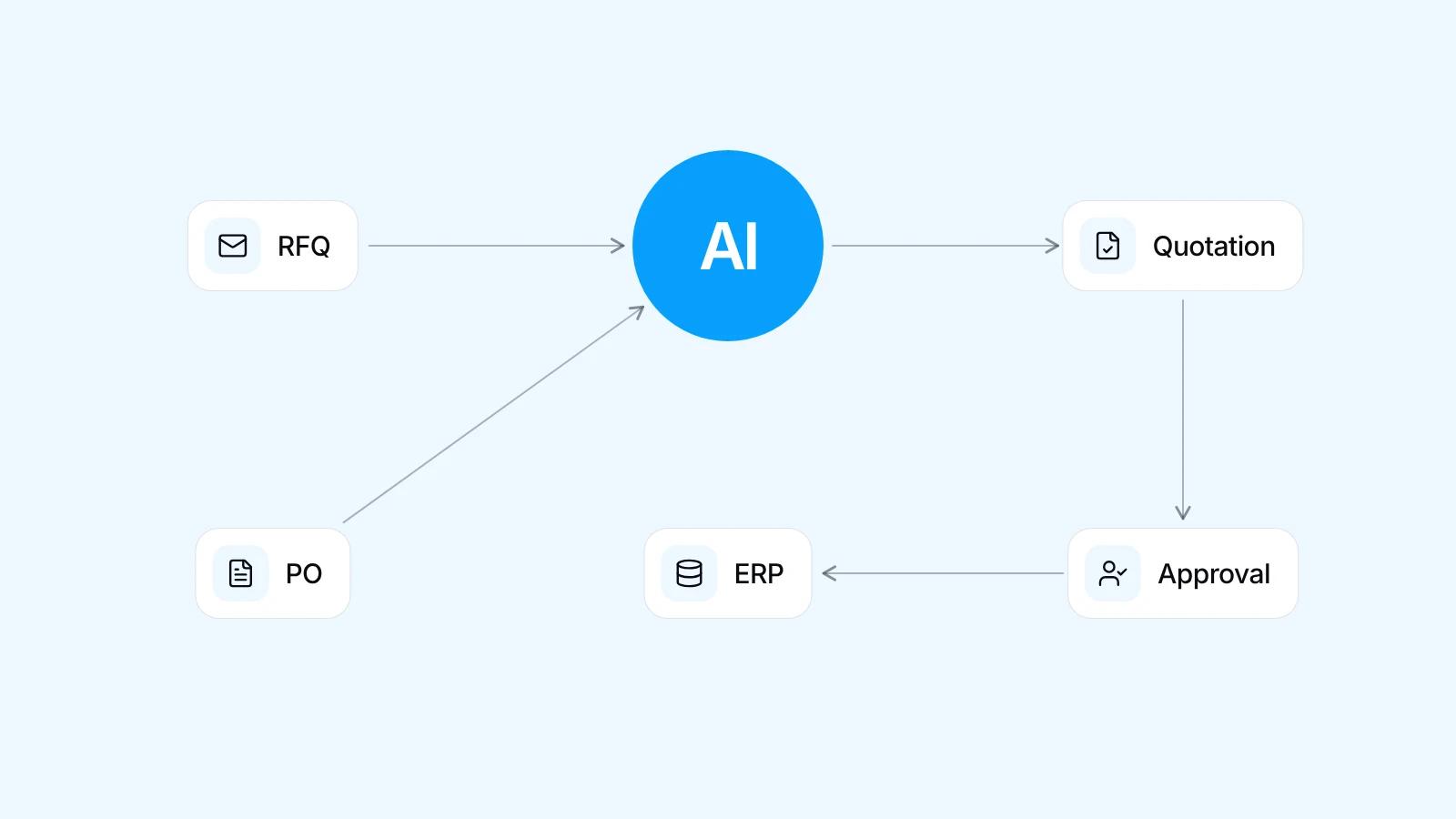
- AI drafts quotations from email or WhatsApp, and sales checks and sends them
- Purchase order PDFs become draft orders that admin approves before they are saved
- Technical answers come from your spec sheets and manuals, with the source shown
- Discounts, payment terms and delivery promises stay with the people who hold authority
- Each customer's terms are used only within that customer's own account
Why AI for B2B companies needs its own approach
B2B sales rarely close in one conversation. One account can involve a purchasing officer asking for a quote, an engineer checking specifications and a finance team handling payment terms. Cycles are long, products are technical and many customers have their own terms. So answering well is not enough. The AI must know the context of the account and follow your existing approval path, not cut around it.
Quotation automation from email and WhatsApp
Quote requests arrive by email or WhatsApp, sometimes as a photo of an item list or a forwarded PDF, with items described in the customer's own words. The AI reads the request, matches each line to your catalogue, pulls that customer's agreed terms from the system and drafts the quotation in your format. Nothing is sent automatically, because one wrong item code can turn into a wrong delivery.
- Lines it cannot match with confidence are flagged, not guessed
- Sales checks, edits where needed, approves and sends
- Every approval is logged: who approved it and when
Technical and after-sales questions answered from product documents
Distributors and manufacturers field many questions whose answers are already written down: part compatibility, materials, dimensions, standards met, maintenance steps. Those answers sit in spec sheets, catalogues and manuals that only a few people know well. AI for distributors and manufacturers can search those documents first and answer with the source named, so your team can check it.
For after-sales, installation questions and minor faults are answered from the manual, while complaints, warranty claims and returns go to a staff member with a summary. The key rule: when the documents hold no answer, the AI must say it does not know. Language models tend to fill gaps with confident sentences, which is dangerous with technical products.
Purchase order PDFs turned into order records
Each customer sends purchase orders in its own layout, and admin retypes them. The AI reads the PDF, picks out the customer, items, quantities, delivery address and date, and builds a draft order checked against your quotation, so differences show up at once. Admin still saves the order. Blurry scans or tables split across pages get a closer look, and the system marks what it is unsure of.
Sales follow-up and management reports
Long sales cycles leave many quotations hanging. AI for B2B sales teams can spot quotes that have gone quiet, remind the salesperson who owns the account and draft a follow-up from the conversation history. The salesperson decides when and how it goes out, because B2B relationships are built by people. For management, it turns sales and order data into a readable report of open quotes, orders on hold and quiet accounts, with every figure taken from the system.
Customer terms, data access and approvals
In B2B, each customer's terms are confidential. An AI answering customer A must not be able to quote customer B's discounts or payment terms, so access is set per role and per account. We also agree with you which data may go to the AI model, who can read conversation logs and what the provider's data terms say. Sensitive fields the task does not need stay out of the prompt, meaning the instructions and context sent to the model.
How Metanotech starts with a B2B company
We begin with a free WhatsApp consultation with no commitment, then map the flow from incoming request to outgoing invoice. We pick one process that often swamps the team and has a clear owner, such as quotations for one product line. If your product data was never written down properly, the first job is tidying that data, not adding AI.
Design and development run together, so you see progress directly. Your team uses the first module in daily work before the next one starts, with success measures agreed up front. Our AI portfolio includes work close to B2B operations: WhatsApp assistants for billing and business reports, and AI features in a warehouse app linking stock, purchasing and customer service conversations.
| Process | What AI does | What the team keeps |
|---|---|---|
| Quotations | Reads email or WhatsApp requests and drafts from the catalogue and customer terms | Setting discounts, approving and sending |
| Technical and after-sales questions | Answers from spec sheets and manuals, naming the source | Cases outside the documents, warranty claims, technician visits |
| Purchase orders | Turns the PDF into a draft order and flags differences from the quote | Checking and entering the order |
| Sales follow-up | Flags quiet quotations and drafts a follow-up message | Deciding when and how to contact the buyer |
| Management reports | Summarises sales and order data and answers questions in plain language | Reading the figures and deciding |
Frequently asked questions
Should the AI send quotations straight to customers?
No, not on its own. The AI drafts the quotation, and a salesperson or manager with authority checks, edits and approves it before it goes out. A B2B quotation carries discounts, payment terms and delivery promises that bind your company, and AI can misread a request or pick the wrong item code. Approval also leaves a record of who approved what.
Can AI read purchase orders that look different for every customer?
Yes, for PDFs with readable text and reasonably clear scans. The AI extracts the customer, items, quantities and delivery date into a draft order. Blurry documents, handwriting or tables split across pages need a closer check, so the system marks the parts it is unsure about, and admin approves before anything is saved.
What if our spec sheets and manuals are messy?
You can start anyway. Begin with the product line customers ask about most: collect its latest spec sheets and manuals, remove old versions and name who keeps them updated. AI answers are only as good as their sources, so unanswered questions are logged and used to fill the gaps step by step.
Can this connect to the ERP we already use?
Yes, as long as your ERP has an API, the doorway a system offers for exchanging data with other systems, or can export and import data. The AI reads the catalogue, customers and order history from it and writes draft quotations or orders that wait for approval. If the old system is fully closed, we discuss options such as a new module for your workflow.
How much does AI implementation for a B2B company cost?
Pricing depends on what you need and the scope of the work. Tell us about it on WhatsApp, the consultation is free, and we will send you a proposal that fits.
Who on our side needs to be involved?
One person who knows the process is enough, usually the sales lead or a senior admin, plus access to the data involved. That person gathers sample requests, past quotations and purchase orders, reviews the trial results and decides when the next process starts. Management mainly sets the approval rules and success measures.
Related services
Start a project
Tell us the problem.We'll build the fix.
Free consultation on WhatsApp. Tell us about your business, what you want to build, and what is getting in the way.